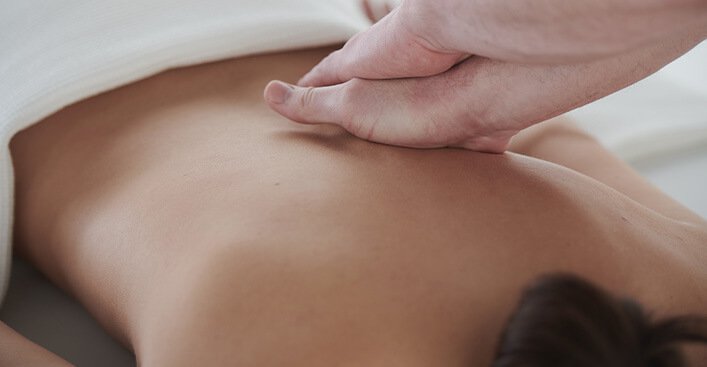
In fact, when looking for information on massage, more people search for "back massage" than for shoulders, knees, hands, neck or any other part of the body.
Your back has so many hard-working muscles and ligaments that it's easy to experience strain and pain in different areas throughout your life. According to the National Institute of Neurological Disorders and Stroke, back pain is the second most common neurological ailment in the United States. And the American Chiropractic Association estimates that eight of every ten people are troubled by back pain at some point.
BACK TENSION
Your back does a constant balancing act. It helps you sit upright, bend forward, twist side to side, and stay steady while you move throughout the day. Back tension develops when the muscles responsible for that support stay engaged for too long without enough recovery. Instead of turning on and off as needed, they remain subtly active, which creates a feeling of tightness or deep muscle fatigue.[1]
Back tension can develop simply by engaging in the daily activities that activate your back. Sitting for long stretches, standing with uneven weight, lifting more using your back than your legs, or even holding your body rigid during stressful moments can all encourage muscles to stay braced. Because the back plays such a central role in nearly every movement, small habits can stack on top of each other.
Acute, worsening pain, or back pain that is accompanied by other, troubling symptoms might indicate a more serious underlying issue and should be discussed with your doctor.[2] But if your tension can be best described as a dull ache, a heavy feeling across your back, or soreness that lingers even after you change positions, you may be experiencing back tension.
In many cases, back tension is simply a sign that these hard-working muscles haven’t had a chance to fully relax. With the right approach, it’s possible to help them release that built-up effort and feel more at ease again.
STUDYING BACK PAIN
The Journal of the American Academy of Family Physicians reports that when controlled studies tested the effects of therapeutic massage, it was found that people experiencing back pain received greater relief from soft tissue manipulation and massage than from a placebo.
When a study in the International Journal of Neuroscience compared massage therapy to muscle relaxation, the group of test subjects who received massage reported feeling less anxiety, pain and depression than people in the other group.
FINDING RELIEF
Massage can help alleviate the muscle spasms which occur when your rib or thoracic joints lose mobility, thereby helping those joints function better. It's even possible to increase the mobility of your sacroiliac joint or tailbone by massaging the gluteal muscles and releasing tension in the tissues.
Along with enhancing other types of medical treatment, back massage therapy can provide significant relief of incidental or chronic pain. Whether chronic pain is due to limited mobility of the vertebral, pelvic and rib joints or to compression of nerves through muscle spasm, disease or structural dysfunction, it helps to find a professional therapist who's experienced in back massage.
BACK TENSION RELEASE
Because the back contains large, layered muscle groups that work together to support nearly every movement, tension there often isn’t limited to one small spot. Instead, it spreads across the upper, middle, or lower back, creating areas that feel dense, fatigued, or difficult to relax. Back tension release works best when care is directed at those overworked muscles in a focused, intentional way.
For people wondering how to release tension in the back without overwhelming sensitive tissues, targeted approaches can help apply consistent, controlled stimulation to muscles that have been working overtime. A massage therapist at a Massage Envy franchised location can recommend services or enhancements designed to focus on unlocking tension.
Rapid Tension Relief may be an effective way to potentially release back tension and help prepare your body to fully benefit from the muscle relaxation. A Theragun® percussive massager helps your massage therapist reach deeper muscle layers, such as those on your back, more efficiently. Whether you choose to incorporate a Rapid Tension Relief enhancement into your massage session or book a 30-minute Rapid Tension Relief session prior to your massage, you complement the hands-on techniques of back massages to relieve tension, especially in areas that feel tight or fatigued.
RELAXATION AND WELLNESS
In addition to pain relief, massage can provide other benefits. Massage Envy takes a proactive role in improving your overall health, because regular massage therapy helps your body maintain a higher level of relaxation. This helps reduce stress, improve sleep and increase the endorphins that act as natural mood boosters.
Your body can function better after a massage because of increased circulation, which brings newly oxygenated blood to your muscles and transports metabolic waste away from your internal organs. Back massage therapy also provides greater flexibility, since relaxed muscles and limber joints allow for improved range of motion.
TYPES OF MASSAGE
Depending on your goals and situation, your massage therapist may recommend one specific type of massage or a blend of several. These include:
- Swedish or Relaxation Massage -- the most common in America with gentle, light to medium pressure
- Deep Tissue Massage -- deeper pressure across the grain of your muscles
- Hot Stone Envy® -- which uses smooth, water-heated stones to increase circulation and relax muscles
Each type of massage has its own benefits, so be sure to discuss your back pain with your therapist. You may decide on one particular massage style and repeat it with every visit, or you may decide to combine various styles at different times. Either way, you'll discover how back massage can make you feel more relaxed and relieved of pain, stress and tension